
Future Lab: 3D Molecular Visualization
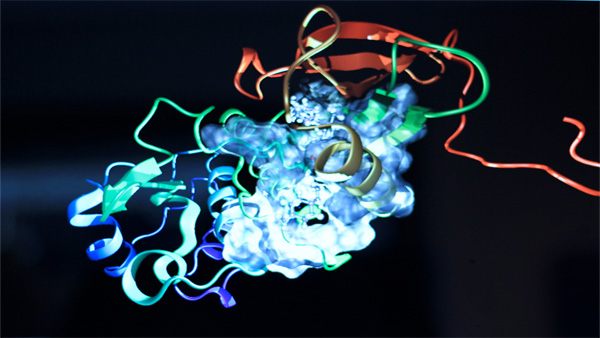
Advances in interactive molecular graphics enable not only creative research, but an increasingly collaborative and mobile research community to interact. In the “VIsualization Vault,” at the University of California, San Francisco, Professor Tom Ferrin and his team created Chimera, a visualization system for exploratory research. Ferrin, one of the pioneers of visualization, leads UCSF’s computer graphics lab. He spoke with Future Lab about his research and its role in ongoing scientific innovations.
At Intel Tech Heaven 2011, in New York City, researcher Hans-Christian Hoppe spoke with Future Lab about his research. Along
with Professor Phillip Slusallek, he’s part of the team that developed the BALLview graphics program. Their work is based at the Intel Visual Computing Institute Saarland, and has already been noted for its use of ray tracing to model molecules with depth perception (and, more importantly, for its promise in addressing human needs like cures for the flu and other diseases).
For years, there has been a vibrant online dialogue at sites like the PLoS Computational Biology open-access journal; MyBioSoftware and blogs like bytesizebio.net. Now, in addition to the information sharing that communities engage in online, there’s the additional possibility of extreme mobility. The research community is increasingly likely to examine molecular imaging on a phone or tablet, and as likely to do so in an unconventional research facility, like a backyard or a coffee shop.
Interviewees:
Thomas E. Ferrin, Ph.D., Professor of Pharmaceutical Chemistry, Bioengineering and Therapeutic Sciences Chair, Biological and Medical Informatics Graduate Program Director, Resource for Biocomputing, Visualization, and Informatics at University of California, San Francisco.
Hans-Christian Hoppe, Principal Engineer, Director of Operations at Intel Visual Computing Institute, Saarland.
Tom Goddard, Programmer, UCSF Computer Graphics Laboratory; Developer, Chimera
Links and White Papers:
Photo set on Flickr
3D models of molecular structures
Science and Technology Center for Visual Computing
Resource for Biocomputing, Visualization, and Informatics (RBVI)
Professor Phillipp Slusallek, Developer of Intel’s BALLview computer modeling program, Saarlend University Computer Graphics Lab & Intel Visual Computing Institute Saarbrücken, Germany
Future Lab radio is sponsored by Intel Labs and is available on Intel Free Press and through iTunes
.
Posted in:
Audio Podcast, Corporate, Future Lab Radio, Intel, Intel Free Press, Intel Labs, Research@Intel